Insights
23.12.2025
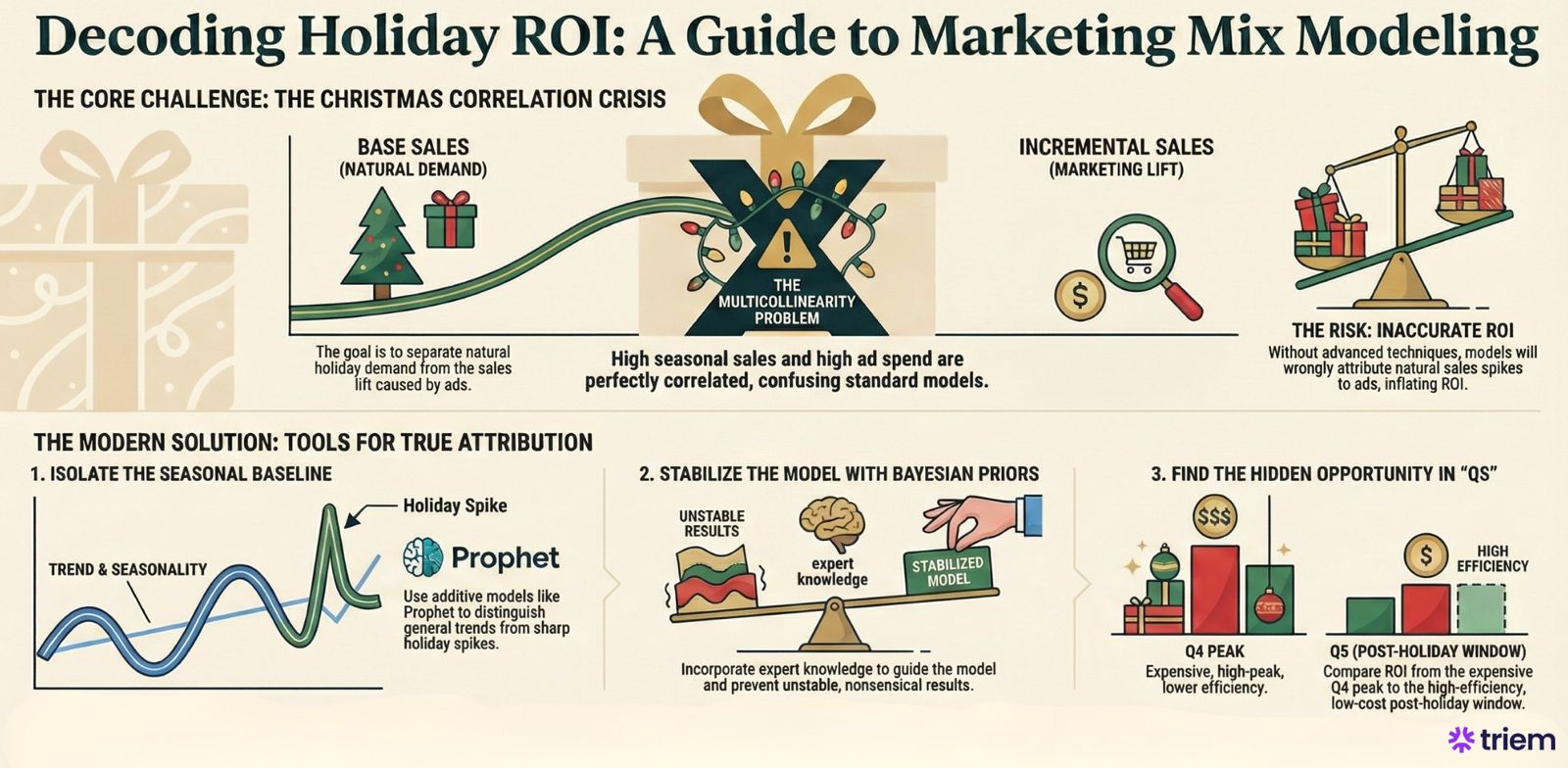
If you look at your Q4 sales chart, the spike looks incredible. But as a marketer, you face a core challenge: The Christmas Correlation Crisis. Is that revenue a result of your brilliant ad campaign, or did the "holiday spirit" do the heavy lifting?
In Marketing Mix Modeling (MMM), seasonality isn’t just a calendar event—it’s a data trap. If we don’t separate natural demand from marketing lift, we end up with inflated ROI and a broken budget for next year.
Here is how to look past the "Holiday Halo" using MMM.
1. The Multicollinearity Problem: The Silent Model Killer
The biggest headache in holiday modeling is Multicollinearity. During Q4, two things happen simultaneously: natural holiday demand peaks, and ad spend hits its yearly high. Because these two variables are perfectly correlated, standard models get "confused."
The risk? Inaccurate ROI. Without MMM, the model will wrongly attribute natural organic sales to your ads, creating a false sense of efficiency.
2. Isolate the Baseline
To find the truth, we must first isolate the Seasonal Baseline. This means separating long-term growth trends from sharp, short-term holiday spikes.
Using additive models like Prophet, we can "de-average" the data. By stripping away the predictable holiday surge, we can finally see the Incremental Sales—the actual lift that only happened because of your marketing efforts.
3. Stabilize with "Expert Knowledge"
Sometimes the data alone isn't enough to break the correlation crisis. This is where Bayesian Priors come in.
Instead of letting the model guess wildly, we incorporate "expert knowledge" to guide it. By feeding the model known constraints and historical insights, we prevent nonsensical, unstable results and ensure the ROI figures reflect reality, not just statistical noise.
4. The Hidden Opportunity: The "Q5" Window
Most marketers focus entirely on the Q4 Peak, but that’s often the most expensive and lower-efficiency period due to high competition.
Triem MMM reveals a hidden gem: Q5 (The Post-Holiday Window). By comparing the high-cost Q4 peak to the high-efficiency, low-cost window immediately after the holidays, brands often find they can achieve better ROI when the "noise" of the holiday season settles down.
💡 The Verdict
You can’t fight the holiday calendar, but you can decode it. A 30-minute meeting is enough to discuss how we can do this together. Let's meet!


Ibrahim Tokgöz
Managing Partner